

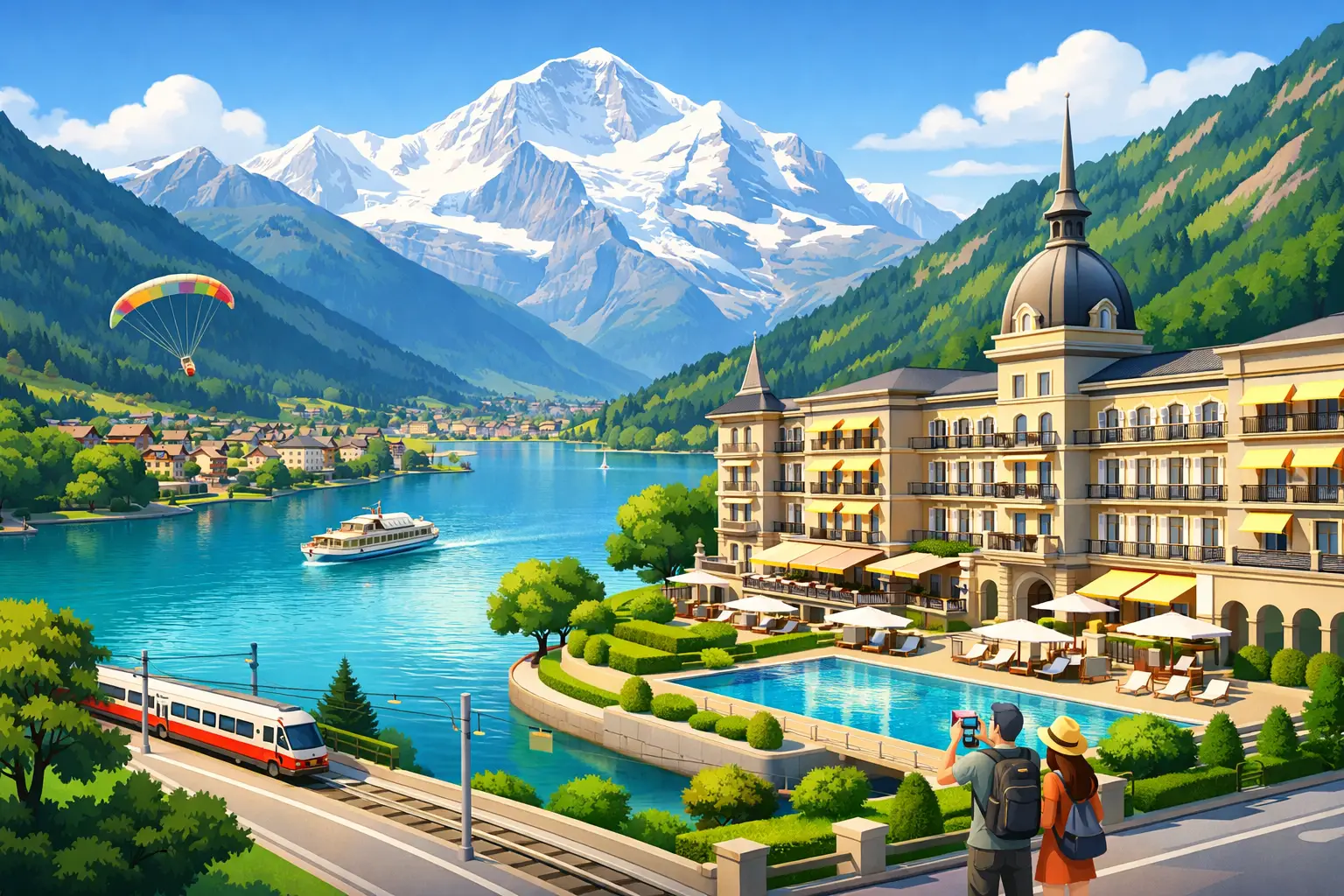
Interlaken rewards good planning. Arrive at the right time, choose the right side of town, and understand how the Grand Hotel Victoria Jungfrau fits into the rhythm of the destination, and the entire stay becomes calmer, smoother, and far more enjoyable. If you are wondering how to visit Interlaken and Grand Hotel Victoria Jungfrau without wasting time on avoidable logistics, the key is to treat transportation, timing, and hotel positioning as part of the experience.
This is not a destination where you want to improvise after landing. Interlaken sits between Lake Thun and Lake Brienz, with mountain excursions radiating outward in several directions. That sounds simple on paper, but for travelers with luggage, tight schedules, family members, or business commitments, small planning mistakes can quickly turn into missed connections, unnecessary walking, and a less polished arrival than expected.
How to visit Interlaken and Grand Hotel Victoria Jungfrau efficiently
The most practical approach starts with your point of entry into Switzerland. Many international visitors arrive via Zurich or Geneva, while some private travelers and executive guests come through Bern-area access points. Your ideal arrival route depends on how much time you have, how many transfers you are willing to manage, and whether Interlaken is your main destination or one stop on a broader Swiss itinerary.
If your priority is independence and scenic rail travel, trains are reliable and well organized. Interlaken is served by two main stations, Interlaken Ost and Interlaken West. That detail matters because the Grand Hotel Victoria Jungfrau is near Interlaken West, not Interlaken Ost. Visitors often assume the stations are interchangeable. They are not, especially if you are arriving with formalwear, ski luggage, family baggage, or simply a preference for a composed arrival.
A private chauffeur transfer is often the better fit when you value direct routing, privacy, and control over the schedule. For hotel guests arriving after a long-haul flight, for executives moving between meetings, or for travelers continuing on to Grindelwald, Lauterbrunnen, or Gstaad after Interlaken, direct transport removes the weakest point in the journey – multiple handoffs. In a destination built around precision and comfort, that trade-off is easy to justify.
Choosing the best arrival route
From Zurich, Interlaken is straightforward, but not always friction-free if you are traveling at peak times. Rail connections are frequent, yet platforms, luggage handling, and crowded carriages can feel less than ideal after an overnight international flight. Geneva works well too, though the transfer is longer and demands more attention to timing.
If your schedule is light and you enjoy public transport, train travel gives you flexibility and excellent scenery. If your schedule is tight or your standards are high, a door-to-door car service is usually the more efficient decision. It allows you to arrive directly at the hotel entrance, avoid navigating station areas, and keep the pace of the day under your control.
There is also a style question here. The Grand Hotel Victoria Jungfrau is not the sort of property guests choose by accident. It attracts travelers who appreciate service, discretion, and a well-managed stay. Arriving in a way that matches that environment tends to improve the experience from the first minute.
Understanding the location of Grand Hotel Victoria Jungfrau
The hotel occupies a prime position in central Interlaken, with easy access to the town center and onward excursions. That makes it appealing for both leisure and mixed-purpose trips, particularly when one day is dedicated to the Jungfrau region and another to dining, shopping, or private appointments.
Its location near Interlaken West is useful because it places you close to one of the town’s more convenient arrival points while still keeping the mountains within easy reach. You are not isolated in a resort bubble, but you are also not forced into a highly practical, low-character station hotel experience. That balance is one of the property’s strengths.
For first-time visitors, it helps to know that Interlaken itself is often a base rather than the final attraction. Guests stay here for access to higher alpine destinations, lake excursions, premium dining, and polished hospitality. The hotel works especially well if you want a refined home base with simple onward movement.
When to go, and what changes by season
Interlaken works year-round, but the right season depends on why you are coming. Summer offers long days, green landscapes, lake activity, and the broadest range of sightseeing options. It is ideal for first visits and for travelers who want classic Swiss scenery without winter logistics.
Winter is more selective. It suits guests combining Interlaken with nearby mountain destinations, seasonal events, or quiet luxury stays. The town remains active, but weather can affect visibility, road conditions, and excursion schedules. That does not make winter difficult – it simply means your transportation plan should be tighter.
Spring and fall can be excellent if you prefer fewer crowds and a calmer atmosphere. The trade-off is that some experiences feel more weather-dependent. A premium stay in Interlaken still works beautifully in shoulder season, but your plans should have some flexibility.
For guests staying at Grand Hotel Victoria Jungfrau, summer and early fall are often the easiest choices. Mountain access is broader, daylight is generous, and the arrival experience feels more forgiving if you are coordinating several elements of the trip.
What to plan before you arrive
The strongest Interlaken itineraries are not overfilled. This region looks compact on a map, yet many headline experiences involve movement by train, car, cable car, or boat. Trying to fit too much into one stay usually creates rushing instead of enjoyment.
Before arrival, decide whether your trip is centered on relaxation, mountain sightseeing, or a mix of both. If the hotel itself is part of the reason for the visit, leave time for that. Guests sometimes book a prestigious property and then spend every waking hour in transit. That rarely feels like a premium experience.
If you plan to visit Jungfraujoch, Lauterbrunnen, Grindelwald, or nearby lakes, organize those days in advance around realistic departure times. If you are traveling with children or older family members, build in more margin than you think you need. Swiss transport is efficient, but efficiency does not eliminate fatigue.
This is also where professional ground transport becomes valuable. A chauffeur can turn a multi-step day into a clean sequence, especially if you need station drop-offs, private waiting time, restaurant transfers, or onward travel after checkout. For guests who expect reliability without constant coordination, that is often the difference between a trip that feels managed and one that feels fragmented.
How to move around once you are in Interlaken
Interlaken is walkable in parts, but walkable does not always mean convenient. Weather, luggage, eveningwear, shopping bags, and family needs all change what feels easy. The area around the hotel is pleasant for walking, particularly in good weather, and many guests will enjoy moving around the center on foot.
For broader outings, your transport choice should match the occasion. Rail is useful for mountain excursions. Private car service is better for direct appointments, scenic touring on your schedule, or evenings when you want punctual pickup and a quiet return. The best solution is often mixed use rather than loyalty to one method.
That matters for business travelers as well. If you are attending a private event, arriving for a meeting, or hosting guests in the region, appearance and timing count. A carefully managed transfer protects both.
How to make the hotel part of the trip, not just the address
Grand Hotel Victoria Jungfrau makes the most sense when you treat it as a destination within the journey. Guests who merely sleep there and rush out at dawn miss what the property does best – creating a sense of arrival, privacy, and ease in one of Switzerland’s most recognized resort settings.
Plan at least one unhurried evening and one slow morning. That is often enough to let the stay feel distinct rather than transactional. If your trip includes celebrations, executive travel, or a special occasion, coordinate your arrival and departure times around the hotel experience instead of treating them as afterthoughts.
This is especially relevant if you are booking premium transportation. A polished arrival at the hotel, baggage handled properly, and a scheduled departure for your next destination create continuity. For guests used to high service standards, continuity is not a luxury extra. It is the baseline.
A provider such as Berner Limousine fits naturally into that kind of planning because the service logic matches the destination – direct, discreet, and structured around the guest rather than the timetable.
Common mistakes to avoid
The most common mistake is assuming Interlaken can be handled casually on arrival. It can, but only if you are traveling light, on a flexible budget, and with plenty of time. Most premium travelers are not looking for that kind of uncertainty.
The second mistake is underestimating the importance of station choice. If you are train-bound, confirm whether your routing brings you to Interlaken West or requires a last segment after Interlaken Ost. That one detail can reshape your arrival.
The third is overbooking your days. Interlaken is better when each transfer has purpose. One excellent mountain excursion and a well-paced hotel stay usually outperform three rushed outings.
If you want the trip to feel effortless, plan the invisible parts first. Arrival, station choice, luggage handling, and onward movement are what make Interlaken and Grand Hotel Victoria Jungfrau feel as refined as they should.