

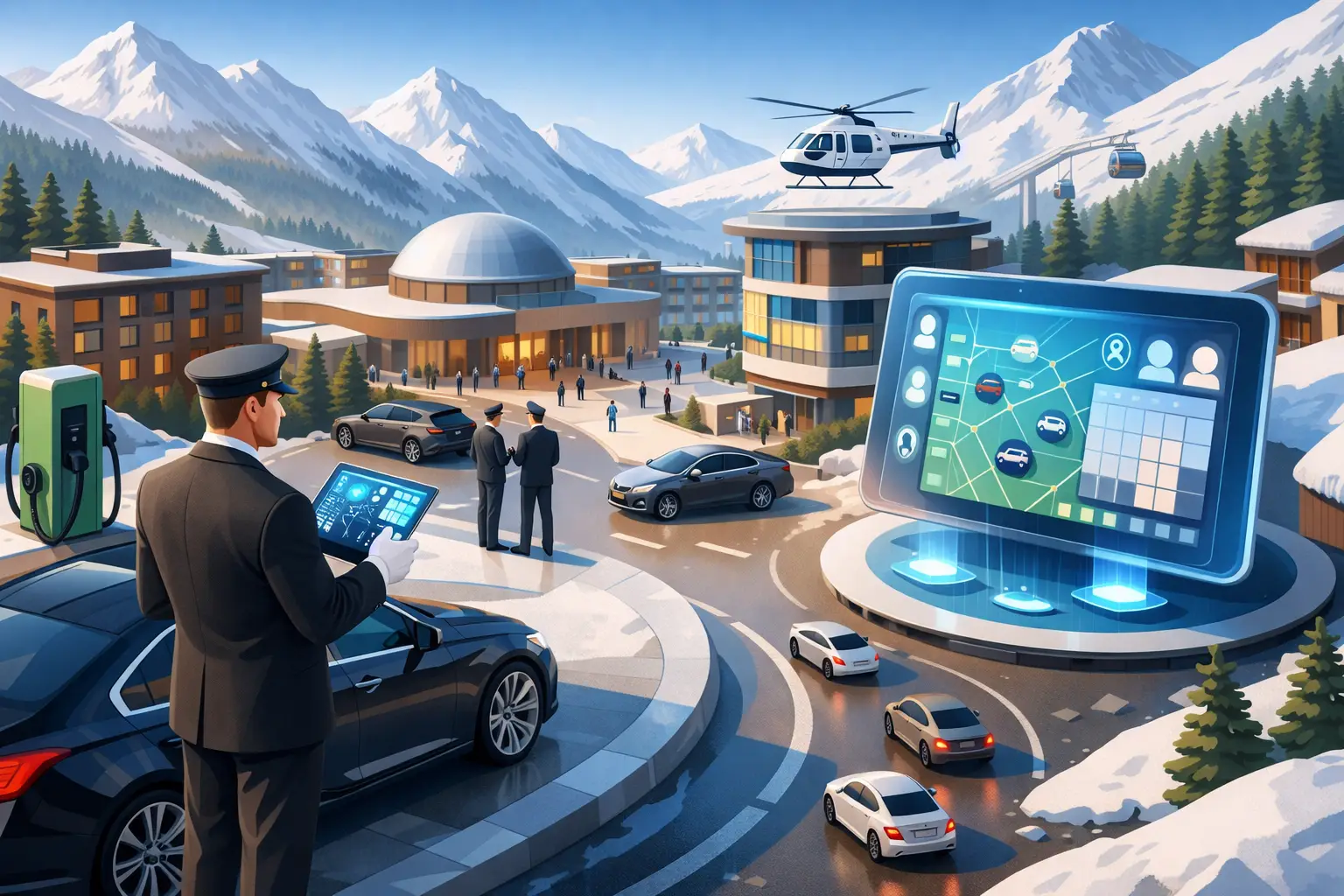
A Davos program can appear straightforward on an itinerary: airport arrival, hotel check-in, a sequence of meetings, and a return flight. During the World Economic Forum period, that apparent simplicity disappears quickly. The davos wef challenge 2027 will require organizations, private guests, and hospitality teams to treat ground transportation as a managed operational element rather than an afterthought.
For executives and delegations, the relevant standard is not simply reaching Davos. It is arriving composed, protected from avoidable delays, and ready for the next appointment. That depends on early planning, accurate passenger information, a capable chauffeur team, and a transport partner accustomed to sensitive, high-profile movements.
Why Davos Requires a Different Transport Plan
Davos is a mountain destination with a concentrated event footprint. During WEF, limited road capacity, enhanced security measures, busy hotel access points, weather exposure, and tightly scheduled arrivals all affect how a transfer unfolds. A journey that is comfortable under normal circumstances may require considerably more coordination during the forum week.
The challenge is often not the route itself. It is the number of decisions around it: Which airport best supports the passenger’s schedule? How much contingency time is appropriate? Where should the vehicle wait between meetings? Who communicates schedule changes? What happens when an arrival is delayed or a meeting runs over?
These questions matter equally for a single executive and a multi-car delegation. The appropriate setup depends on the number of passengers, luggage requirements, level of security, hotel arrangements, and the degree to which schedules are likely to change. A professional chauffeur service should clarify these details before the journey begins, not while the client is waiting curbside.
Davos WEF Challenge 2027: What Is at Stake
At a global forum, time has commercial and diplomatic value. Missing a meeting, arriving flustered, or managing transport logistics personally creates an unnecessary burden for people whose attention should remain on negotiations, relationships, and decisions.
A well-managed chauffeur operation provides more than a vehicle. It creates continuity between appointments. The chauffeur tracks the agreed itinerary, understands the required pickup procedures, handles luggage with discretion, and maintains a calm, professional presence. For international guests, multilingual communication can also remove friction at precisely the moments when schedules are under pressure.
Discretion is not an optional refinement in this environment. Passenger names, travel patterns, hotel locations, and meeting schedules should be handled with restraint. The most effective service is often unobtrusive: the car is ready, the route is prepared, and the passenger does not need to ask twice.
Arrival Planning Starts Before the Flight Lands
Airport transfers deserve particular attention during WEF travel. Private and commercial arrivals may be subject to different timing, access, and coordination requirements. Flight delays, baggage collection, immigration procedures, and changing arrival instructions can all affect the pickup plan.
The most reliable approach is to provide the chauffeur partner with flight information, passenger contact details, luggage expectations, hotel destination, and any known onward commitments. This allows the dispatch team to monitor the movement and adapt the collection process where necessary.
For guests arriving through Zurich, Geneva, or Bern, the airport choice should reflect the full itinerary, not only the flight availability. A later arrival may be entirely workable with a well-prepared long-distance transfer. Conversely, a seemingly convenient arrival can become less efficient if it leaves too little margin before a key appointment. The correct decision depends on the passenger’s priorities and the day’s schedule.
Build an Itinerary That Can Absorb Change
A Davos itinerary should not be planned to the minute. The right buffer is not wasted time. It is what protects the schedule when traffic controls, weather conditions, security procedures, or extended meetings intervene.
For senior travelers, it is usually sensible to assign one primary chauffeur and vehicle for the full working period whenever feasible. Continuity helps the chauffeur learn preferences, recognize recurring locations, and anticipate the rhythm of the program. It also gives the client one dependable point of contact on the road.
For companies managing several guests, a central transport coordinator is equally valuable. This person can approve changes, consolidate requests, and prevent conflicting instructions from reaching chauffeurs. A clear chain of communication is especially useful when assistants, event teams, hotel staff, and corporate security are all involved.
The itinerary should distinguish between fixed commitments and flexible movements. A confirmed panel, airport departure, or formal dinner requires firm planning. Informal meetings and potential evening engagements need an agreed procedure for short-notice adjustments. With 24/7 availability, a chauffeur partner can remain responsive, but clear expectations still lead to better execution.
Vehicle Selection Should Serve the Assignment
Premium transportation is not defined by appearance alone. At WEF, the vehicle must fit the passenger group and its practical requirements. An executive traveling alone may value a quiet, spacious sedan for calls and preparation. A small delegation may need an executive van that keeps colleagues together and accommodates luggage without compromise.
Winter suitability also matters. Mountain conditions can change quickly, and vehicles must be properly prepared for the season. Experienced chauffeurs combine careful driving with route knowledge and realistic judgment. The aim is not to make a difficult journey look dramatic. It is to make it feel controlled.
For high-profile movements, the service standard should remain consistent regardless of vehicle type: immaculate presentation, punctual positioning, discreet assistance, and a chauffeur who understands when conversation is welcome and when privacy is preferred.
The Details Hotels and Delegations Should Confirm
Hotels, executive assistants, and event organizers often carry the practical burden of guest mobility. Early confirmation prevents the most common problems. Before the program begins, agree on pickup locations, preferred contact methods, passenger manifests where appropriate, luggage arrangements, and contingency contacts.
It is also worth confirming whether the vehicle should remain on standby or return for a later pickup. Standby service offers flexibility for fluid schedules, while point-to-point transfers can be more suitable for clearly defined movements. Neither approach is universally better. The right choice depends on how fixed the agenda is, how many changes are anticipated, and how important immediate vehicle access is to the passenger.
For group operations, document vehicle assignments in a format that is easy for the client team to use. Confusion over which car serves which guest can undermine an otherwise excellent transport plan. A professional dispatch operation keeps this information current while respecting the confidentiality of everyone involved.
A Professional Standard for High-Pressure Travel
The forum environment rewards preparation, but it also demands calm reactions when plans change. A chauffeur who knows the region, communicates clearly, and remains composed under pressure can protect a client’s time and privacy throughout a demanding day.
Berner Limousine supports executive travel with premium Mercedes-Benz vehicles, multilingual chauffeurs, and discreet coordination for airport transfers, hotel movements, hourly service, and intercity journeys. The objective is straightforward: dependable mobility that reflects the expectations of guests traveling for consequential business.
For the davos wef challenge 2027, the strongest transport plan is the one passengers barely notice. Their vehicle arrives when expected, their chauffeur is prepared, and every transfer leaves room for what matters most: the conversations waiting at the next door.