

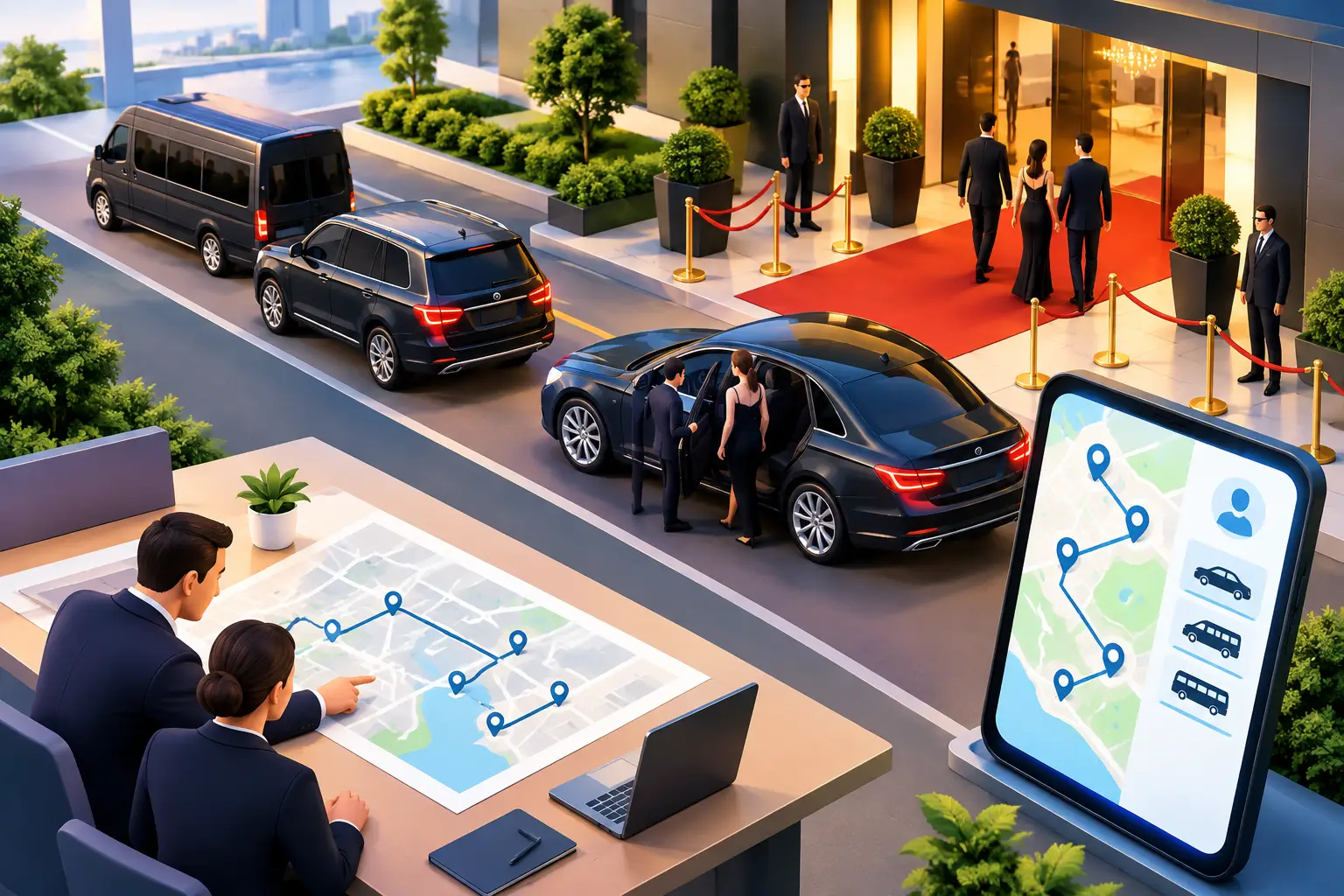
A successful event can lose its rhythm in the space between the airport, hotel, venue, and evening program. This event mobility planning example shows how organizers can manage that movement with the same care they apply to the guest list, security concept, and program schedule. For executive groups and VIP guests, transportation is not a background detail. It is the first personal impression of the event and often the last.
The objective is not simply to provide vehicles. It is to ensure that every guest arrives at the right place, at the right time, in the right setting, with a clear point of contact when plans change. That requires a coordinated transport concept rather than a collection of individual bookings.
Why Event Mobility Needs Its Own Plan
Conference venues, hotels, airports, private residences, and dinner locations rarely operate on the same timetable. Flights arrive early or late, speakers need private transfers, and a group departure can create pressure at the venue entrance within minutes. A standard shuttle arrangement may work for a straightforward group, but it can be insufficient when guests have different status levels, schedules, languages, or security requirements.
A professional mobility plan defines responsibilities before the first guest lands. It identifies who travels when, with whom, in which vehicle category, and under which communication process. It also makes room for the realities of live events: traffic restrictions, weather in alpine destinations, delayed flights, last-minute itinerary changes, and guests who leave earlier than expected.
For companies, hotels, and event agencies, this preparation protects more than punctuality. It supports discretion, keeps hosts available for their guests rather than occupied with logistics calls, and creates a composed experience even when circumstances change.
Event Mobility Planning Example: An Executive Conference in Bern
Consider a two-day executive conference in Bern for 120 international guests. The program includes arrivals via Zurich Airport, Geneva Airport, and Bern Airport; accommodation across two central hotels; a daytime conference; an off-site dinner; and staggered departures the following morning. Among the attendees are 12 board members, several speakers, and guests traveling with personal assistants.
The event organizer’s first decision is to divide transportation into service levels. Board members and keynote speakers receive dedicated chauffeur-driven vehicles, allowing their schedules to remain flexible and private. Small executive groups are assigned coordinated premium vans or sedans based on luggage volume and arrival times. Guests arriving within similar time windows may travel together, but only where this does not create long waiting periods or diminish comfort.
This distinction matters. Combining every airport arrival into a shared transfer can appear efficient on paper, yet it often shifts inconvenience onto the guests who matter most. Conversely, assigning a private vehicle to every attendee may be unnecessary when the itinerary is structured and groups arrive together. The right balance depends on guest profile, event purpose, distance, and the level of discretion required.
Before the Event: Building the Movement Schedule
Planning begins with a complete transport manifest, ideally finalized several days before the event. The manifest includes flight numbers, arrival and departure times, mobile contact details, hotel assignments, luggage requirements, preferred languages, and any special considerations. For senior guests, it should also record whether an assistant, security detail, or family member is traveling with them.
The mobility coordinator then works backward from the program. If the opening session starts at 9:30 a.m., guests should not simply be told to leave their hotel at 9:00. The plan must account for boarding time, the drive, venue access, registration, and a reasonable buffer. For VIPs, the arrival route and entrance may differ from the main group to preserve privacy and avoid congestion.
A detailed operational schedule could include these movements:
- Airport meet-and-greet coverage from the first morning arrival until the final evening flight
- Dedicated executive transfers for board members and speakers
- Timed hotel-to-venue departures in several waves rather than one crowded departure window
- A standby vehicle near the conference venue for itinerary changes or urgent individual transfers
- A coordinated return plan after the dinner, including early departures and late-night availability
The schedule should identify a single transportation lead from the organizer’s side and a corresponding dispatcher or chauffeur lead. Guests should never need to decide whom to call when their flight is delayed or their meeting finishes ahead of schedule.
Arrival Day: From Flight Tracking to Hotel Check-In
On arrival day, flight tracking and active communication are more valuable than a fixed printed schedule. A chauffeur who knows a flight is delayed can adjust the meeting time without the guest having to explain the situation after landing. For international travelers, a clear arrival message with meeting-point instructions reduces uncertainty before they enter the terminal.
At Zurich or Geneva Airport, the plan should consider walking distances, baggage collection times, and the availability of suitable meeting points. A professional chauffeur meets the guest in the agreed location, assists with luggage, and provides a calm transition from travel to the event program. This is particularly relevant for guests arriving after long-haul flights or attending a meeting shortly after landing.
For the conference example, board members are brought directly to their hotel or, where timing requires, to a private meeting room near the venue. Other guests are transferred in planned windows to avoid a prolonged queue at hotel reception. The transport coordinator receives live status updates without distributing operational details to the wider event team.
During the Program: Protect the Schedule Without Making It Feel Rigid
Event transportation should be visible only when guests need it. During the conference, chauffeurs and vehicles are positioned according to the program rather than waiting in a prominent line outside the main entrance. The dispatch team monitors session timing and remains prepared for a speaker who needs to leave for an airport transfer or an executive who requests a confidential meeting elsewhere in the city.
For an off-site dinner, departure waves are especially useful. The first wave may carry guests who need extra time for accessibility or early networking, while the main group follows after the final session. Senior guests can depart separately if they have media obligations, security protocols, or a different arrival route.
A strong plan also sets clear expectations for hosts. If a vehicle is intended to be on standby, the host needs to know how to request it. If a group transfer has a fixed departure time, that timing must be communicated politely and early enough to avoid a rushed atmosphere. Premium service is not about imposing rules on guests. It is about making the right option ready before they have to ask.
Contingencies That Deserve Attention
The best mobility planning anticipates disruption without overcomplicating the event. Weather can affect transfers to Gstaad, Interlaken, or mountain hotels. A late inbound aircraft can change the order of arrivals. Road closures, demonstrations, or a high-profile public event may alter normal routes through a city.
For this reason, the plan should include reserve capacity and decision rules. A standby chauffeur and vehicle may be justified for a senior delegation, while a smaller event may only require the ability to redeploy a nearby vehicle. The appropriate approach depends on the consequences of a missed connection or delayed appearance.
Communication must also remain controlled. Guests should receive concise, useful updates, not a stream of operational messages. The transportation lead should know who may authorize schedule changes, who receives status reports, and how confidential guest information is handled. This is especially relevant for diplomatic, corporate, and celebrity guests.
Choosing the Right Chauffeur Partner
An event mobility provider should be assessed on operational discipline as much as vehicle presentation. Luxury vehicles matter, but they are only one part of the experience. The chauffeur must be punctual, discreet, professionally presented, familiar with local routes, and able to communicate confidently with international guests.
For complex programs, ask whether the provider can coordinate multiple vehicles, monitor flights, cover early-morning and late-night movements, and adapt to changes without placing the burden on the organizer. Multilingual chauffeurs and a reliable dispatch structure are particularly valuable when guests arrive from several countries.
Berner Limousine supports event and congress mobility with chauffeur-driven Mercedes-Benz vehicles, personal coordination, and availability around the clock. For organizers, this means transportation can be managed as one accountable service rather than a series of separate arrangements.
The most effective event mobility plan feels effortless to the guest because the work happened beforehand. When each transfer has an owner, each guest has a clear route, and the team has a prepared response to change, the event begins with confidence well before the first session opens.