

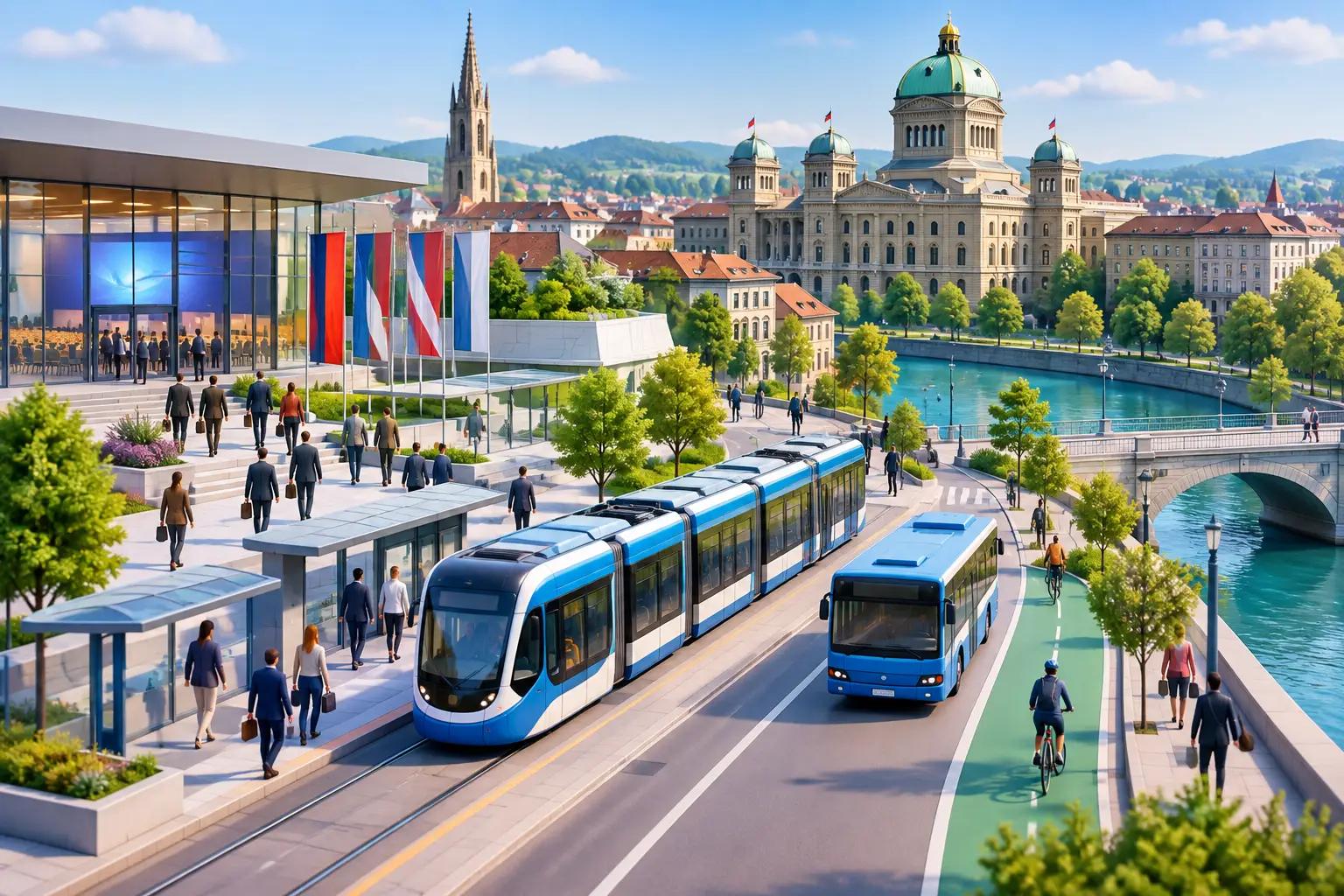
A congress schedule can be precise to the minute and still fail at the curb. A keynote speaker lands late, a delegation finishes a private meeting ahead of time, or several guests leave different hotels for the same venue. Bern congress mobility planning turns these moving parts into a controlled operation, protecting punctuality, privacy, and the standard expected by senior guests.
For organizers, corporate hosts, hotels, and executive assistants, transportation is not simply a transfer between two points. It is part of the guest experience and, often, the first operational impression of an event. The right plan gives every participant clear instructions, gives the organizer visibility, and gives the chauffeur the information needed to act calmly when the schedule changes.
Why Bern Congress Mobility Planning Requires Detail
Bern is compact enough that a drive can look straightforward on paper. During a major congress, however, airport arrivals, hotel departures, security procedures, loading areas, traffic peaks, and parallel programs quickly create pressure. A vehicle arriving five minutes late may delay an entire panel. A vehicle arriving too early without a defined waiting point can cause confusion at a restricted entrance.
The central task is to design the flow, not just reserve cars. This begins with understanding who is traveling, when they need to move, and what level of attention each journey requires. A single executive traveling from Bern Airport to a hotel has different requirements from a 30-person board group, international speakers with changing flight schedules, or VIP guests who need discreet access away from the main entrance.
A professional chauffeur operation also needs the authority to make sensible adjustments. Flight delays, a program running over, or a last-minute change of venue should not result in a chain of calls to multiple drivers. A dedicated coordination process allows vehicles and chauffeurs to be assigned with enough flexibility to respond while maintaining the agreed service standard.
Start With the Guest Journey, Not the Vehicle Count
The most reliable mobility plan maps each guest journey from arrival through departure. Organizers should identify airports and rail stations, hotels, congress venues, private dinners, satellite meetings, and any off-site program. This creates a working picture of travel demand across the full event rather than treating every ride as an isolated booking.
Arrival planning deserves particular attention. International guests may arrive at different times in Zurich, Geneva, or Bern, sometimes with tight connections and luggage requirements. Clear arrival details, preferred contact channels, flight monitoring where appropriate, and an agreed meeting procedure help prevent uncertainty after landing. For high-profile travelers, discretion may mean a quieter meeting location and minimal visible coordination.
Departure planning should receive the same care. Guests often leave immediately after a closing session, while others require a transfer after a private meeting or dinner. When departures are grouped only by flight time, organizers can overlook baggage collection, hotel checkout, security buffers, and the time needed to move through a busy venue. The best plans build in realistic margins without making guests wait unnecessarily.
Segment Guests by Service Need
Not every attendee needs identical transportation, and treating them all the same can waste capacity or weaken the experience for key participants. A useful plan separates travelers into practical groups: speakers and moderators, executive leadership, VIP or diplomatic guests, staff and organizers, and larger delegations.
Speakers need dependable arrival at a specific entrance with enough time to prepare. Executive guests may need a quiet vehicle between meetings to review notes or take calls. Larger groups require vehicle capacity and departure windows that keep people together without creating long waits. VIP and diplomatic movements may require confidential schedules, limited circulation of contact information, and chauffeurs experienced in formal protocols.
This segmentation is not about creating unnecessary complexity. It allows the transportation team to match the vehicle, chauffeur profile, pickup procedure, and communication style to the actual assignment.
Build a Schedule That Can Absorb Change
Congress programs are living documents. A late flight, extended discussion, weather disruption, or security hold can affect several subsequent transfers. For that reason, mobility planning should use time windows rather than relying entirely on rigid pickup times.
A well-run schedule identifies the non-negotiable movements first: airport arrivals, speaker calls, venue openings, and departures tied to flights. It then places flexible transfers around those anchors. Where several guests attend the same dinner or reception, staggered pickup times can prevent congestion at hotel entrances and venue loading zones.
The operational plan should include named contacts on both sides: one person who can make event decisions and one transport coordinator who can execute them. It should also define how changes are communicated. Messaging works well for routine updates, but urgent changes need a direct phone contact and a clear decision-maker. In a time-sensitive environment, a message seen ten minutes too late is not a solution.
For multi-day events, a short daily review is valuable. The next day’s flight movements, agenda changes, vehicle positions, and special requests can be confirmed before the evening ends. This is especially helpful when guests are traveling between Bern and other Swiss destinations for dinners, site visits, or onward meetings.
Choose Vehicles for the Assignment
A premium fleet should support the event program rather than become a decorative detail. Sedans are well suited to individual executives, speakers, and airport transfers. Larger luxury vehicles serve small delegations, families, luggage-heavy arrivals, and group movements. The right choice depends on passenger count, baggage, travel time, and the degree of privacy required.
Vehicle presentation matters, but it is only one part of the assignment. Guests also expect a clean, quiet cabin, a chauffeur who knows the route and venue procedures, and enough space to travel comfortably in business attire with documents or luggage. For longer transfers, the ability to work or rest without interruption can be decisive.
The same principle applies to chauffeur selection. Multilingual communication is helpful for international congresses, while local familiarity is essential when entrances, hotel access points, and temporary traffic arrangements are involved. Professional discretion is particularly important when guest lists, meeting locations, or travel patterns are sensitive.
Protect the Venue Experience
Transportation affects what guests see at the venue. A poorly planned arrival can produce queues, blocked entrances, confused guests, and staff forced to manage vehicles instead of welcoming attendees. Before the first pickup, the chauffeur team should know the correct access points, waiting areas, loading restrictions, and onsite contacts.
For larger programs, it is often better to establish a controlled arrival sequence than to send all guests at the same moment. The approach depends on the venue and the profile of attendees. A leadership summit may prioritize quiet, individual arrivals. A company event may benefit from timed group movements that create a more organized check-in.
The return journey deserves equal attention. Guests leaving after evening receptions are often tired, ready to make calls, or managing an early departure the next morning. A visible but unobtrusive pickup process gives them confidence without turning the venue exit into a staging area.
What to Confirm Before the First Guest Arrives
The final operational briefing should convert the event plan into assignments that can be executed without guesswork. It should confirm guest names and contact preferences, arrival and departure data, pickup locations, venue access details, luggage needs, vehicle assignments, chauffeur contacts, and escalation procedures.
It should also identify sensitive assignments separately. These may include executives whose schedules are not shared broadly, guests requiring special assistance, or movements that need a specific security protocol. Information should be shared only with the people responsible for delivering the service. Discretion is strongest when it is built into the process, not added as a last-minute request.
Berner Limousine supports congress and event mobility with experienced chauffeurs, premium Mercedes-Benz vehicles, and 24/7 coordination for demanding schedules in Bern and across Switzerland. The objective is straightforward: guests should feel expected at every stage of the journey, while organizers remain focused on the congress itself.
A successful congress is remembered for the quality of its conversations, not for a missed pickup or a crowded curb. Put the mobility plan in place early, appoint clear points of contact, and leave enough room for real-world changes. That is how transportation becomes a quiet source of confidence throughout the event.