

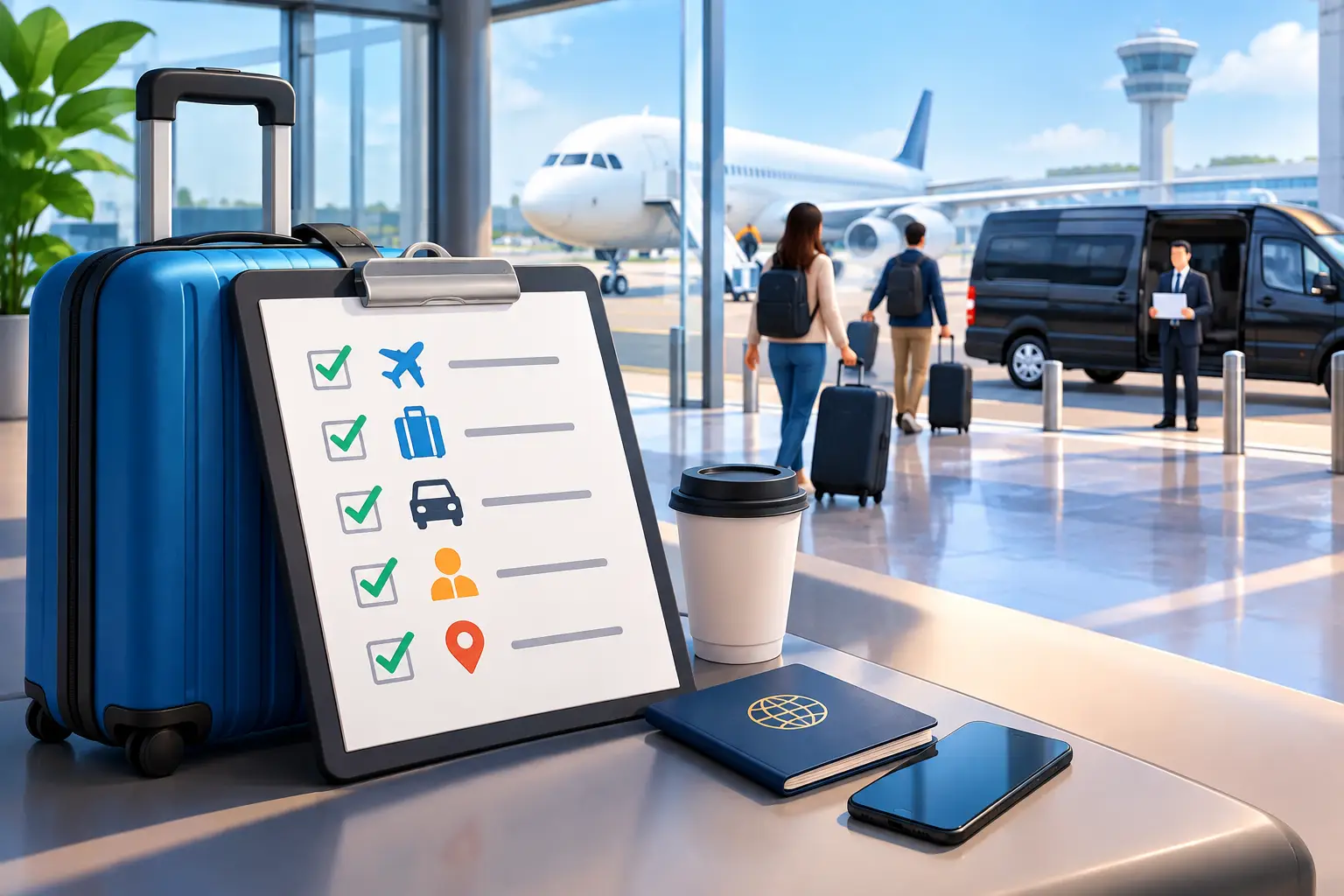
A delayed checked bag, an unexpected customs queue, or a changed arrival gate can turn a carefully planned trip into an unnecessary wait. A considered airport arrival checklist gives you control over the details that matter after landing – especially when a meeting, hotel check-in, private event, or onward journey is already scheduled.
For business travelers, families, VIP guests, and international visitors, the objective is not simply to leave the terminal. It is to arrive composed, informed, and on time. The following checklist focuses on the practical decisions that make an airport arrival predictable, comfortable, and appropriately discreet.
Airport Arrival Checklist Before You Land
The arrival process begins before the aircraft reaches the gate. About 30 minutes before landing, confirm that your phone is charged and switched on after arrival. If you have arranged a chauffeur, keep the booking confirmation available, including the pickup instructions, contact number, vehicle details, and flight number.
A flight number is more useful than a scheduled landing time. Gates change, aircraft wait for a stand, and delays can occur before the doors open. A professional chauffeur service monitors the flight rather than relying only on the original timetable, but it remains sensible to advise the dispatch team if your flight is rerouted or you have made a last-minute change to your itinerary.
Keep your passport, entry documents, hotel confirmation, and any onward rail or flight information together in a place you can reach easily. Avoid packing them in carry-on luggage that may be stored several rows away. For travelers entering Switzerland or another Schengen destination from outside the area, the time required for passport control varies considerably. A first-class transfer plan allows for that uncertainty rather than making assumptions about a fast exit.
At the Gate: Allow Time for the Real Arrival
Landing is not the same as being ready for pickup. Deplaning may take a few minutes or considerably longer, particularly after a long-haul flight or when the aircraft parks remotely. Travelers seated near the rear, those requiring assistance, and families with young children should build in additional time.
Once inside the terminal, follow the signs for passport control, baggage claim, connections, or arrivals. If you are unsure which route applies to your journey, ask airport personnel before committing to a long walk in the wrong direction. International airports can have separate exit routes depending on whether you arrived from a Schengen or non-Schengen location.
For travelers with tight schedules, this is also the moment to send a brief message to your office, host, or hotel. A simple note confirming that you have landed is often more useful than promising an exact arrival time before you have cleared formalities.
Passport Control and Customs
Have your passport open to the relevant page before you reach the front of the line. If required, keep visas, residence permits, invitation letters, or supporting travel documents ready. Answer questions clearly and briefly. Business travelers carrying specialized equipment, samples, or high-value items should know in advance whether declarations are required.
Customs is usually straightforward for ordinary personal luggage, but it should never be treated as an afterthought. Rules differ according to your country of origin and what you are carrying. If you are uncertain about an item, declaration requirements, or permitted quantities, ask the relevant officials. A few minutes of clarification is preferable to disrupting the rest of your itinerary.
Baggage: Check Before You Leave the Hall
At baggage claim, verify that every suitcase, garment bag, cabin item, and piece of specialist equipment is present before leaving the area. Look closely at luggage tags if several bags are similar in appearance. This is particularly relevant for groups, executive delegations, and event guests traveling with presentation materials or formal attire.
If a bag does not arrive, report it at the airline desk before exiting the baggage hall. You will typically need your passport, boarding pass, baggage receipt, and a clear description of the item. Keep the report reference and provide an address where the bag can be delivered. A chauffeur can still proceed with your transfer, but the airline process should be started immediately.
Traveling with oversized luggage, skis, golf equipment, musical instruments, or multiple cases requires advance planning. Such items may arrive at a separate belt, take longer to appear, and require a vehicle with suitable luggage capacity. The right vehicle is not determined only by passenger count. It depends on the luggage profile, personal space expectations, and the nature of the onward journey.
Coordinate Your Chauffeur Pickup Clearly
The most common cause of airport pickup confusion is not a late driver. It is an unclear meeting point. Airports often have several exits, terminals, parking areas, and public pickup zones. Before travel, confirm whether your chauffeur will meet you inside the arrivals hall with a name sign or whether the meeting is arranged at a designated exterior point.
Inside pickup offers a more personal welcome and is particularly suitable for first-time visitors, senior guests, families, guests with substantial luggage, or travelers arriving after a long international flight. Exterior pickup can be efficient at smaller airports or for guests who know the terminal well. Neither approach is universally better. The right choice depends on the airport, security rules, group size, and the level of assistance required.
If you cannot see your chauffeur immediately, remain near the agreed meeting point and use the direct contact number provided. Do not leave the terminal to search parking areas unless instructed. A discreet chauffeur service will provide clear identification, assist with luggage, and guide you to the vehicle without unnecessary attention.
Berner Limousine coordinates airport transfers with flight monitoring, professional multilingual chauffeurs, and a service approach designed for guests who value punctuality and discretion. For transfers involving executives, diplomatic guests, wedding parties, or international delegations, sharing the full itinerary in advance allows the service team to prepare for each arrival condition.
Prepare for the Journey Beyond the Airport
Your transfer should reflect what comes next. If you are heading directly to a board meeting, consider whether you need time in the vehicle to review notes, make private calls, or refresh after the flight. If you are traveling to a mountain resort, confirm the destination address, expected weather, and whether the property has a specific entrance or luggage procedure.
For hotel arrivals, provide the hotel name exactly as booked and, where appropriate, the guest name. Large properties may have separate entrances for reception, residences, events, or private villas. For private homes and business sites, share a precise address and any gate, security, or access instructions before the day of travel.
It is also wise to communicate any special requirements in advance. These may include child seats, mobility assistance, a specific language preference, additional waiting time, privacy expectations, or space for equipment. Last-minute requests can often be accommodated, but advance notice enables a more considered and reliable arrangement.
Keep a Practical Arrival Kit Accessible
The items you need immediately after landing should stay with you, not in checked baggage. A small arrival kit avoids searching through suitcases at the terminal or in the vehicle. Include your passport and travel documents, phone and charging cable, payment card, prescribed medication, glasses, a light layer for changing weather, and essential meeting materials.
For a long-haul arrival, add a toothbrush, facial tissues, and a change of shirt or blouse. These small provisions are not about formality. They allow you to step into a meeting, hotel lobby, or private engagement feeling prepared rather than rushed.
A Final Check Before Departure
Before entering the vehicle, take one quiet moment to confirm that you have your passport, phone, wallet, luggage, and any duty-free purchases. This simple pause prevents the most frustrating kind of travel disruption: realizing that an essential item has been left behind only after the car has departed.
A well-managed arrival does not need to feel elaborate. It simply removes avoidable decisions from a moment when you are tired, time-conscious, or responsible for guests. With the right information shared beforehand and a clear plan from aircraft door to final destination, the airport becomes the beginning of your itinerary rather than an interruption to it.