

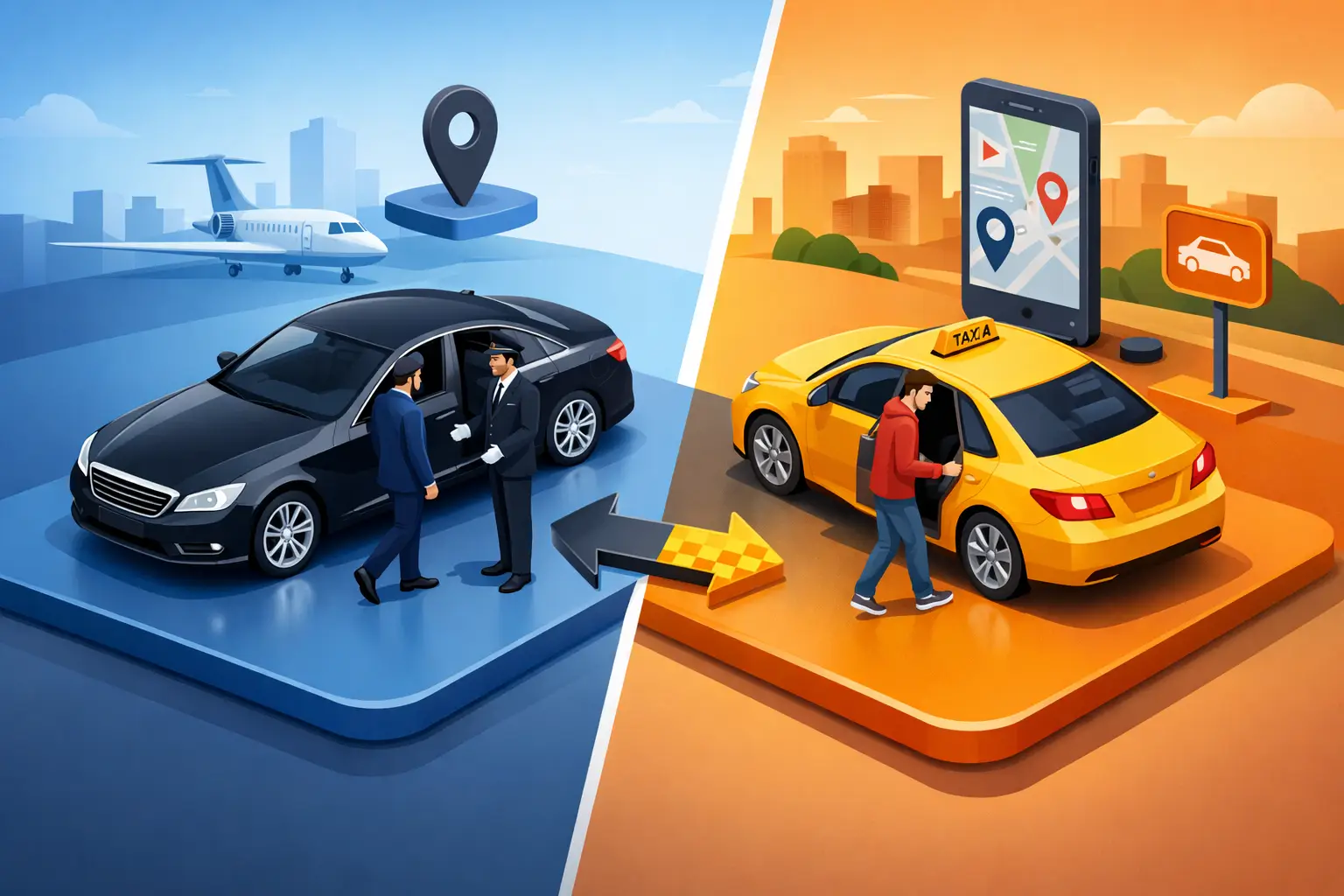
A missed airport pickup can cost more than time. It can disrupt a meeting, unsettle a VIP guest, or start a wedding day with avoidable stress. That is why the question of chauffeur service vs taxi is not just about getting from one point to another. It is about how much certainty, comfort, and professional support you need around the journey.
For some trips, a taxi is perfectly adequate. For others, it is the wrong level of service. The difference becomes clear when timing matters, when presentation matters, or when the passengers expect more than a vehicle and a driver.
Chauffeur service vs taxi: the real difference
At a glance, both services move passengers from A to B. In practice, they are built around different expectations.
A taxi is typically designed for immediate transport. You need a ride, one is dispatched or flagged, and the focus is on completing the route efficiently. That model works well for spontaneous urban travel, short distances, and situations where flexibility matters more than planning.
A chauffeur service is arranged around the passenger, not just the route. The journey is scheduled, monitored, and handled with a higher level of preparation. The vehicle standard is typically higher, the driver is trained for professional service and discretion, and the experience is managed from pickup to arrival with far more consistency.
This distinction matters most when the ride is part of something bigger. An airport arrival for an executive, a transfer for hotel guests, transport for a diplomatic visit, or a full day of meetings requires reliability that goes beyond simply finding the next available car.
When a taxi is the practical choice
There is no need to overstate the case. Taxis have an important role and remain a sensible option in many situations.
If you are making a short trip across town, leaving a restaurant late at night, or traveling with no special requirements, a taxi is often enough. It is familiar, accessible, and useful when plans are changing by the minute. In dense city environments, that convenience can be the deciding factor.
For solo passengers with light luggage and a simple route, a taxi keeps things straightforward. There is usually no need for advance planning, no expectation of a particular vehicle class, and no requirement for a more personalized service model.
The trade-off is predictability. Vehicle condition, driver presentation, route familiarity, and service style can vary. For many everyday rides, that variation is acceptable. For high-stakes transport, it often is not.
When a chauffeur service earns its place
A chauffeur service becomes the stronger choice when the transport itself carries operational or reputational importance.
Airport transfers are a clear example. A chauffeur monitors flight timing, plans the pickup, assists with luggage, and provides continuity even if the arrival is delayed. For business travelers landing in Zurich or Geneva after a long-haul flight, that level of coordination changes the tone of the entire day.
Corporate mobility is another area where the gap widens. Executives, board members, and international guests often need more than a ride. They need punctuality, a polished arrival, quiet space, and a driver who understands when to engage and when to remain discreet. For companies, consistency across multiple bookings matters just as much as the individual trip.
Events, weddings, and VIP movements also favor chauffeur service. In these settings, timing is fixed, expectations are high, and there is little room for improvisation. The driver is part of the service standard. That includes presentation, situational awareness, and the ability to handle changes calmly.
Comfort is not a small detail
People often reduce the comparison to luxury versus utility. That misses the point.
Comfort in chauffeured transport is not only about premium materials or a quieter cabin. It is about arriving composed. After a flight, before a client meeting, or during a full day of appointments, the quality of the vehicle and the smoothness of the service affect how the passenger feels on arrival.
A well-maintained executive vehicle offers more space, cleaner presentation, and a calmer environment. For private clients, that creates a more pleasant journey. For business passengers, it supports productivity and presence. If a traveler needs to take calls, review notes, or simply reset between engagements, the vehicle becomes part of the working day.
That is where a taxi and a chauffeur service often separate most clearly. One is transport. The other is managed travel.
Chauffeur service vs taxi for business travel
Business travelers usually notice the difference fastest because they measure service in reliability, not only convenience.
A taxi may be available quickly, but business travel rarely depends on speed alone. It depends on timing, presentation, and control. If a client or executive must be met at the terminal, transferred to a hotel, then taken on to a meeting schedule, each handoff matters. Delays, uncertainty, or inconsistent service create friction that should never reach the passenger.
A professional chauffeur service is structured to remove that friction. Advance booking, coordinated pickups, experienced chauffeurs, and executive-class vehicles make travel more predictable. For companies that host guests regularly, the benefit compounds over time. The service becomes part of the organization’s standard of hospitality.
There is also a discretion factor. Senior passengers, legal teams, diplomats, public figures, and private families often value a lower-profile, more controlled experience. In those settings, the driver’s judgment is as important as the route.
Planning, flexibility, and peace of mind
One of the biggest practical differences is what happens before the ride starts.
With a taxi, the service generally begins when a car is assigned or hailed. With a chauffeur service, the work starts earlier. Pickup instructions are confirmed, schedules are reviewed, vehicle requirements are matched to the booking, and timing is managed in advance. That preparation reduces avoidable problems.
This matters for multi-stop itineraries, cross-border transfers, hotel coordination, and event transport. It also matters in destinations where guests may be unfamiliar with the local language or logistics. A professional chauffeur service can provide continuity that feels effortless to the passenger, even when the planning behind it is complex.
At the same time, chauffeur service is not always the right answer for every traveler. If your plans are highly spontaneous and the ride is low-stakes, a taxi may remain more practical. The best choice depends on whether convenience or control matters more for that specific journey.
What to look for if service quality matters
If you are deciding between the two, start with the purpose of the trip rather than the category of transport.
Ask whether timing is fixed, whether the passenger needs a higher degree of discretion, and whether the arrival itself carries importance. Consider the luggage, the duration of the transfer, and whether the traveler is arriving tired, working in transit, or representing a company. Those details usually answer the question more honestly than habit does.
It also helps to look beyond the car. Professional transport quality depends on communication, punctuality, driver training, vehicle standard, and the provider’s ability to handle changes without creating stress for the client. In Switzerland, where expectations around punctuality and service are rightly high, these details are often what separate a dependable chauffeur operation from basic point-to-point transport.
For many travelers, the answer is not taxi or chauffeur service in every case. It is using each where it fits best. A taxi for simple local rides. A chauffeur service for airport transfers, corporate travel, special occasions, and any situation where comfort, discretion, and reliability are part of the requirement.
That is usually the clearest way to think about chauffeur service vs taxi. Not which one is better in the abstract, but which one protects the quality of the day ahead. When the journey matters, the right level of service shows long before the vehicle arrives.