

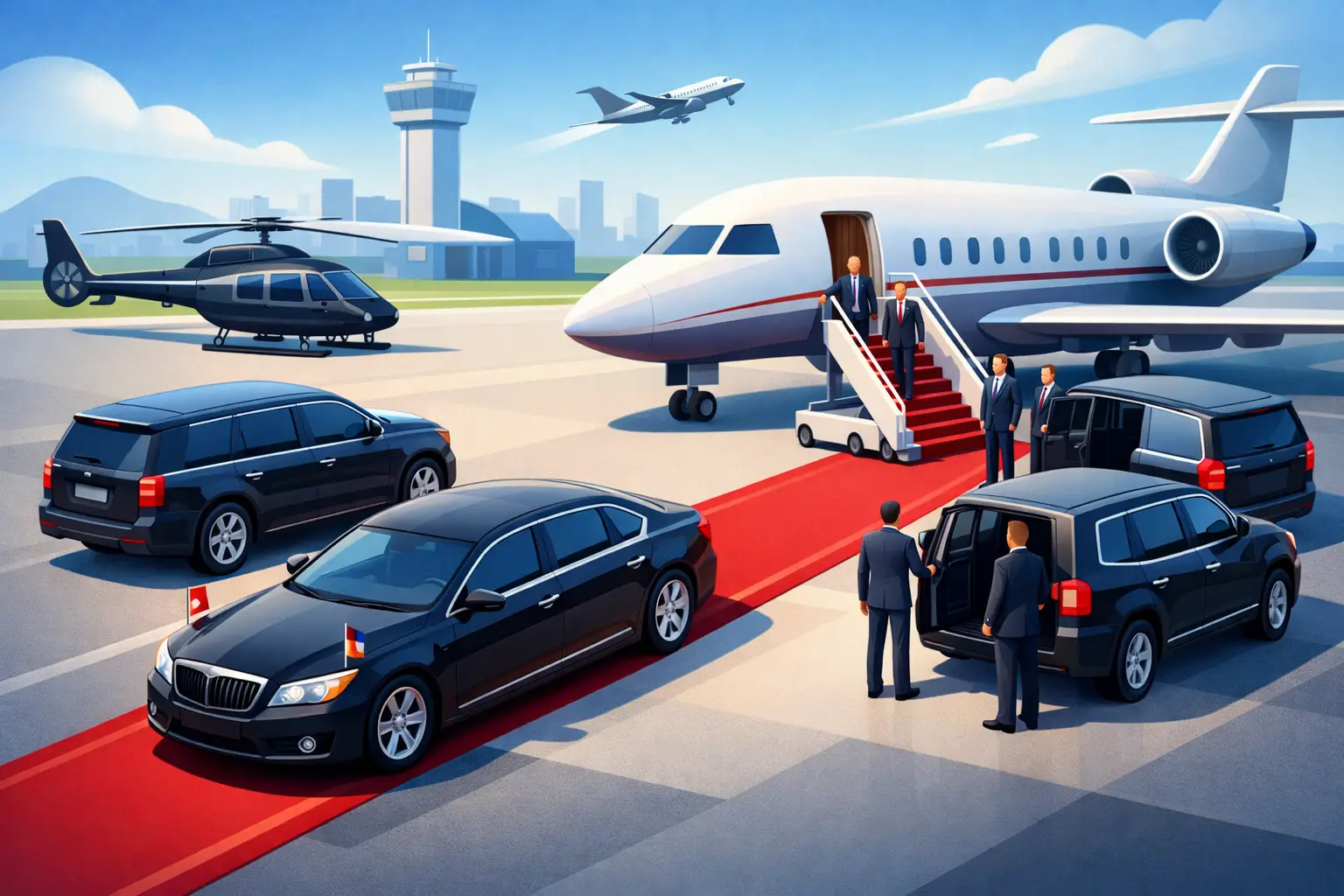
A diplomatic delegation transport example is rarely defined by the vehicle alone. The decisive work happens before the aircraft lands: confirming protocols, aligning with security contacts, assigning the right chauffeurs, and building enough flexibility into the schedule to handle a delayed arrival or an extended meeting without drawing attention.
For an embassy, protocol office, hotel team, or corporate host, transportation is part of the delegation’s first impression of Switzerland. It must be punctual and appropriately formal, while remaining discreet. The best arrangements feel calm to the guests because every relevant detail has already been considered.
A Diplomatic Delegation Transport Example
Consider a visiting delegation of eleven guests arriving at Zurich Airport for a two-day program involving official meetings in Bern and a private dinner with hosts in Geneva. The group includes a senior principal, several advisors, an interpreter, and protocol representatives. Their arrival time is confirmed, but the exact time at which they will leave the airport remains dependent on border formalities, baggage handling, and the host’s security procedures.
The transport plan should not treat the delegation as a single group that simply enters one large vehicle. Different roles require different arrangements. The principal may travel in a dedicated executive sedan with a lead chauffeur. Advisors can travel in a second premium sedan or a luxury van, depending on the desired level of privacy, luggage volume, and security guidance. A separate vehicle may be held in reserve for last-minute changes, additional staff, or an early departure.
The operational contact receives a concise transport brief before the assignment. It contains confirmed flight details, passenger counts, vehicle allocation, hotel access instructions, meeting locations, agreed pickup points, and contact persons. Sensitive personal information is limited to what is necessary for the service. The chauffeur team knows who must be met, where to be, and which person is authorized to make schedule decisions.
Arrival: discreet, clear, and unhurried
At the airport, a diplomatic arrival needs a meeting process that is easy to recognize without becoming unnecessarily conspicuous. Depending on the protocol agreed with the host, the chauffeur or an operations representative waits at a designated point after the relevant arrival procedures. The guests are greeted by name where appropriate, luggage is handled carefully, and the vehicles are positioned for a direct departure.
A professional chauffeur does not press for conversation or request unnecessary information. He confirms the next destination, checks that the delegation is complete, and allows the protocol representative to set the pace. For some delegations, the principal enters the vehicle first and travels independently. For others, the host’s representative rides with the principal. The correct choice depends on protocol, not habit.
The cars should be immaculate, neutral in presentation, and prepared for the journey. That includes appropriate temperature, drinking water if requested, charging facilities, and sufficient luggage capacity. More importantly, it means the chauffeurs have reviewed the route, access restrictions, and alternate approaches before the guests arrive.
Transport Planning Around Meetings and Protocol
A diplomatic schedule is not a standard business itinerary. A meeting scheduled for 10:00 a.m. may require an arrival at the venue much earlier because of access control, receiving lines, press arrangements, or a private pre-meeting exchange. The vehicle’s arrival time and the guest’s arrival time are not always the same thing.
For the Bern meeting, the lead chauffeur may position the principal’s vehicle at a controlled entrance while the supporting vehicles remain nearby but out of view. The operations team confirms where chauffeurs may wait, whether engines may remain running, how pickups will be communicated, and which route should be used after the meeting. This avoids the common problem of vehicles blocking a frontage or being unavailable when a meeting ends earlier than planned.
The group’s advisors may have a separate agenda. One vehicle could take them to a working lunch while another remains assigned to the principal. This is why accurate vehicle-to-passenger allocation matters. Consolidating everyone into fewer vehicles may appear efficient on paper, but it can reduce privacy and create delays when the program divides into parallel appointments.
A qualified chauffeur service also considers the practical transition points. Hotels, government buildings, conference venues, and private residences each have their own access rules. A narrow driveway, a restricted curbside zone, or a hotel entrance shared with other guests can affect vehicle placement. These details are handled in advance whenever possible, rather than being negotiated with a waiting delegation on site.
Security coordination without overstepping
Chauffeur service and close protection are distinct responsibilities. Where official security personnel are involved, the transport provider follows the agreed procedures and coordinates with the designated security liaison. The chauffeur’s role is to drive safely, maintain discretion, respect positioning instructions, and communicate operational changes through the proper contact.
This distinction is especially important when schedules shift. If a venue departure is delayed, chauffeurs should not speculate or seek instructions from individual guests. They remain ready and take direction from the protocol or security lead. If an alternate route is requested, the team follows the approved process rather than making an independent decision based solely on traffic conditions.
Discretion also applies after the assignment. Passenger names, travel patterns, and meeting locations should not become conversation topics. A delegation may be high-profile, but professional service is measured by what remains private.
When the Program Changes at Short Notice
The most useful diplomatic transport plan is not the most complicated one. It is the one that can absorb changes without visible disruption. A flight delay, a meeting that runs long, a revised hotel, or an additional guest can all change the vehicle schedule within minutes.
In this example, the Bern meeting extends by forty-five minutes. The Geneva dinner reservation stays in place, but the group now has less time for the transfer. The transport coordinator updates the chauffeurs, confirms the revised departure sequence with the host contact, and checks the best approved route for current conditions. The principal’s vehicle is brought forward at the correct time, while the supporting vehicles are called into position only when needed.
The guests should not have to manage these details. They should leave the meeting, enter the assigned vehicle, and continue with the program. That is the standard expected of premium diplomatic transportation: preparation that remains largely invisible.
A reserve option is valuable, but it must be proportionate. A large delegation with multiple locations may justify a standby vehicle and relief chauffeur. A smaller delegation with a fixed program may only require carefully timed positioning. The right level of support depends on passenger profiles, route length, security requirements, and the consequences of a delay.
What to Confirm Before Booking
A transport request is easier to execute well when the organizer can provide the essentials early: arrival and departure details, number of passengers, luggage requirements, principal and support-party structure, destinations, vehicle preferences, and the authorized operations contact. It is also helpful to clarify whether the program involves formal protocol, venue access controls, security liaisons, or separate schedules for different members of the delegation.
A premium chauffeur provider should respond with more than a vehicle confirmation. The organizer needs confidence that chauffeurs are experienced, presentable, multilingual where required, and reachable around the clock. They should understand the difference between a high-level private transfer and a coordinated delegation movement with multiple decision-makers.
For assignments across Zurich, Bern, Geneva, and other major Swiss destinations, Berner Limousine provides discreet chauffeur coordination, premium Mercedes-Benz vehicles, and personal operational support for demanding schedules. The focus remains on precise execution, clear communication, and a service standard suited to formal international guests.
The strongest result is not a dramatic arrival. It is a delegation that reaches every appointment composed, on time, and free to focus on the purpose of the visit.