

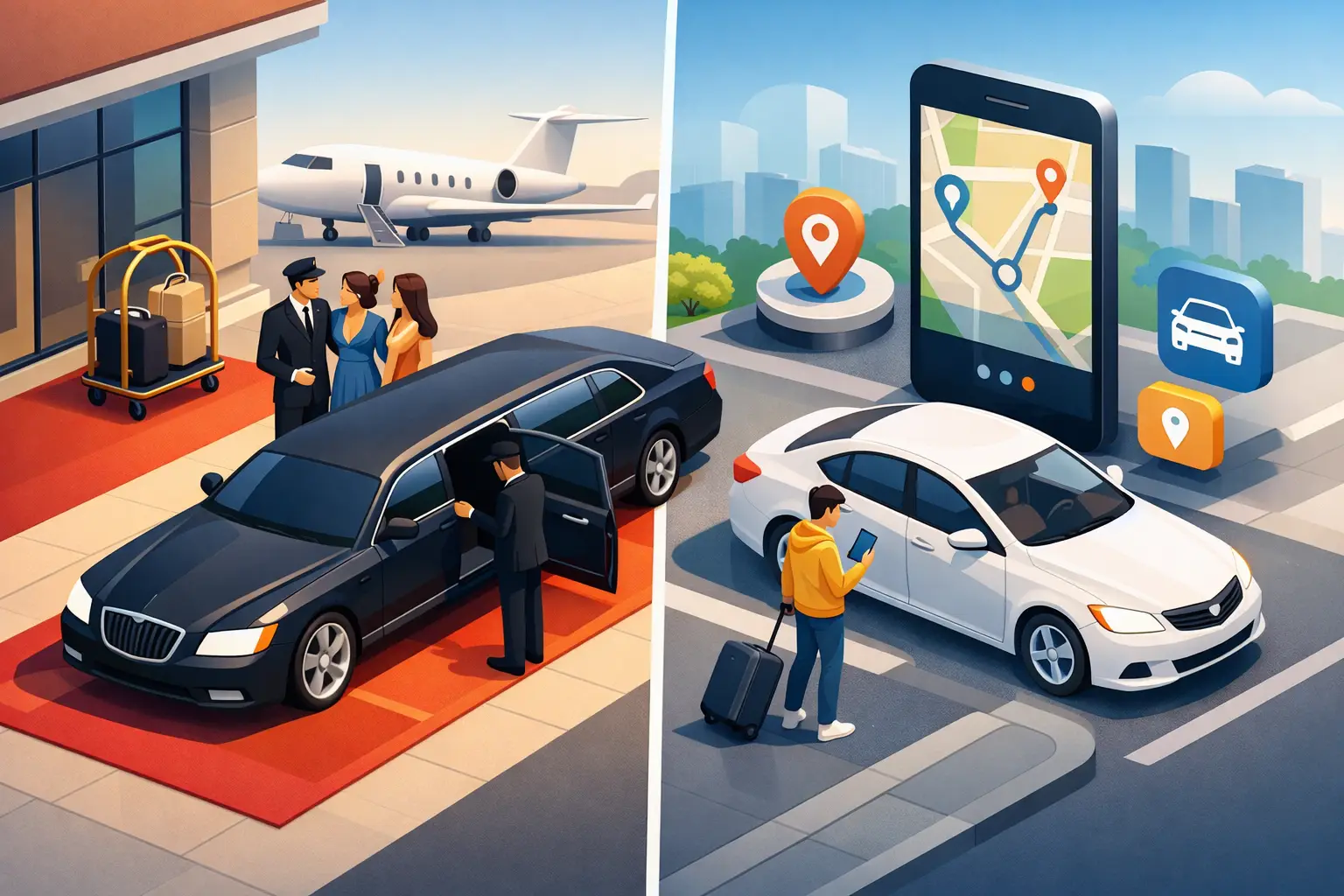
A missed pickup at the airport can cost more than time. It can disrupt a meeting, unsettle an important guest, or put unnecessary pressure on a tightly planned day. That is where the choice between limousine transfer vs ride hailing becomes more than a question of transport. It becomes a decision about reliability, presentation, and control.
For some journeys, a ride-hailing app is perfectly adequate. For others, it introduces too much uncertainty. If you are traveling for business, receiving international guests, attending a formal event, or simply expect a higher standard of service, the differences are immediate once you look beyond the surface.
Limousine transfer vs ride hailing: what actually changes?
At a glance, both services take you from one place to another. The real difference lies in how the trip is managed before you even enter the vehicle.
A ride-hailing service is built for convenience and speed in everyday situations. You request a car on demand, accept the available driver, and travel under conditions that can vary from one booking to the next. That flexibility suits casual, short-notice urban travel well.
A limousine transfer is arranged service. The route, pickup details, timing, vehicle standard, and service expectations are set in advance. The chauffeur is not simply assigned to complete a trip. He is prepared to deliver a professional transfer with punctuality, discretion, and consistency.
That difference matters most when the journey cannot be left to chance.
Reliability is where the gap becomes clear
If you are leaving a dinner in the city at a relaxed hour, ride hailing may be enough. If you are landing after a long-haul flight, crossing a border, traveling to a mountain destination, or managing an executive schedule, reliability becomes the deciding factor.
Ride-hailing platforms depend on driver availability at that specific moment. Demand spikes, weather changes, local events, and late-night shortages can affect wait times and vehicle access. Even when pre-booking is offered, the experience may still depend on real-time availability rather than a chauffeur specifically allocated to your transfer.
A professional limousine transfer works differently. The pickup is scheduled, monitored, and actively managed. Flight arrivals can be tracked. Delays can be accommodated. Meeting points are clear. For hotels, companies, event organizers, and private clients, this creates a level of planning that is difficult to replicate with app-based transport.
For airport transfers in particular, that operational discipline is often the difference between a smooth arrival and a stressful one.
When timing is not negotiable
Some travel days allow room for improvisation. Others do not. A board meeting, a diplomatic event, a wedding, or a guest arrival from overseas usually comes with fixed expectations. In these cases, transport is part of the experience, not an afterthought.
A limousine transfer is designed for that environment. The service standard remains stable because it is built around preparation. That includes vehicle presentation, chauffeur conduct, route awareness, and the ability to adapt professionally when plans shift.
Comfort is not just about the car
People often reduce this comparison to vehicle type, but comfort is broader than leather seats and cabin space. True comfort includes a calm pickup, assistance with luggage, professional driving style, and the confidence that the trip is being handled properly.
Ride-hailing vehicles vary. Some are excellent. Others are less suitable for longer distances, formal arrivals, or clients who expect a premium environment. The level of cleanliness, space, and driver etiquette may differ from one trip to the next.
With a limousine transfer, the standard is part of the service promise. The vehicle is selected for comfort and presentation. The chauffeur understands when to engage and when to remain discreet. That is particularly relevant for executives working in transit, families arriving with significant luggage, or private clients who prefer a quieter, more composed experience.
Comfort also matters on longer routes. A transfer from Zurich to Interlaken, Geneva to Gstaad, or Bern to a hotel in the Alps is not just a quick city ride. The quality of the vehicle and the professionalism of the chauffeur shape the journey in a much more noticeable way over distance.
Discretion and representation matter more than many expect
One of the biggest differences in the limousine transfer vs ride hailing decision is not visible in an app. It is the level of discretion.
For high-profile individuals, company leadership, legal professionals, diplomats, wedding parties, and luxury hospitality guests, transport is often connected to privacy and representation. The driver may be the first person a client, investor, or VIP encounters. That first impression matters.
Ride hailing is transactional by design. It is optimized for convenience at scale. That model does not always align with situations where confidentiality, polished conduct, and consistent service etiquette are essential.
A professional chauffeur service is built for precisely those moments. Discreet handling, formal presentation, and situational awareness are part of the role. For hotels and corporate bookers, that can protect the guest experience. For private travelers, it creates peace of mind.
The difference for business travel
Business travelers rarely evaluate transport on vehicle alone. They care about punctuality, receipt handling, consistency, personal contact, and the confidence that a client or colleague will be looked after properly.
That is why many companies choose chauffeur services for executive travel, roadshows, airport pickups, and event logistics. The value is not just in the ride itself. It is in reducing uncertainty and protecting schedules.
If you regularly move senior staff or guests between airports, offices, hotels, and venues, a limousine transfer offers a more controlled solution than requesting individual rides one at a time.
Cost is only one part of the decision
For purely casual transport, ride hailing can appear like the simpler option. And sometimes it is. A short local trip with no time pressure may not require more.
But premium travel decisions are rarely about the lowest visible fare. They are about total travel value. If a late pickup affects a reservation, a missed connection disrupts a meeting, or a guest receives an inconsistent experience, the real cost becomes much higher than the trip itself.
A limousine transfer offers clarity because the service scope is defined in advance. You know what has been arranged, who is responsible, and what standard to expect. That predictability is especially valuable for assistants, travel managers, concierges, and anyone booking on behalf of someone else.
In that sense, the better question is not which option is cheaper. It is which option carries the lower operational risk for the trip you are planning.
When ride hailing makes sense
A balanced comparison should acknowledge that ride hailing has a valid role. It works well for informal city travel, last-minute personal errands, and short trips where flexibility matters more than consistency. If the journey is simple and the stakes are low, it can be entirely sufficient.
The issue is not that ride hailing is wrong. It is that it is often used for situations where a professionally managed transfer would be more appropriate.
If you are collecting an important guest, arriving late at night, traveling with family, heading to a major event, or moving between destinations on a tight schedule, a limousine transfer is usually the more dependable choice.
How to choose the right service for the journey
The most practical way to decide is to assess the purpose of the trip.
If the journey is casual, local, and time-flexible, ride hailing may be enough. If the journey involves an airport, a corporate agenda, a formal occasion, a luxury hotel arrival, or a need for discretion, a limousine transfer is the stronger fit.
For travelers in Switzerland, this distinction becomes even more relevant on longer intercity routes and resort transfers, where timing, luggage handling, weather conditions, and local knowledge all have a greater impact on the quality of the trip. In those cases, professional chauffeur planning is not an indulgence. It is practical.
Berner Limousine serves exactly this space between standard transport and full executive mobility, where clients expect premium vehicles, experienced chauffeurs, and service that remains composed under pressure.
The right car service should not become part of the problem you are trying to solve. If the day matters, the guest matters, or the schedule matters, choose the option built to carry that responsibility.