

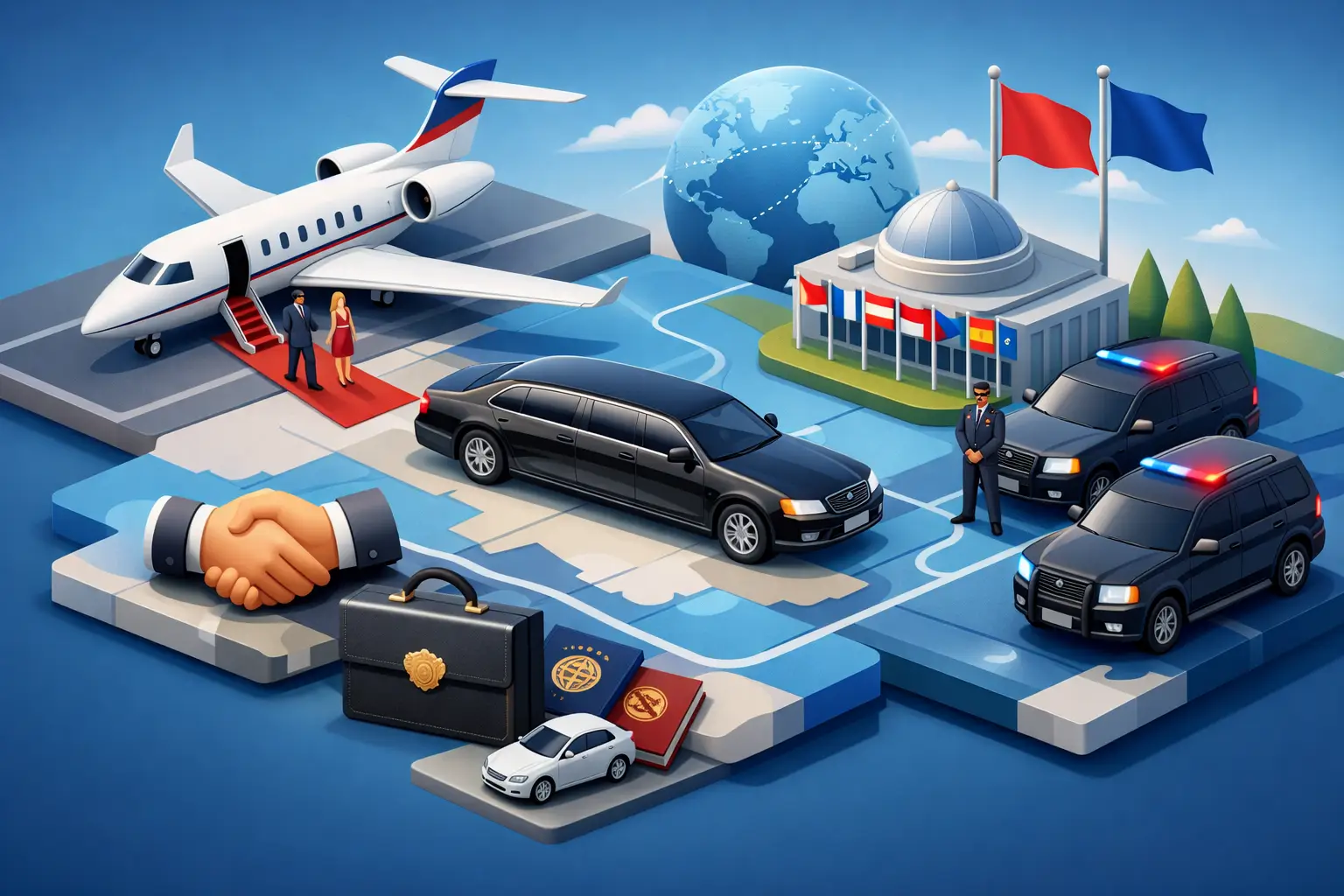
A diplomatic arrival can be disrupted by something as small as an unclear meeting point, a delayed aircraft stand, or one vehicle positioned at the wrong hotel entrance. To plan diplomatic transport properly, every movement must be treated as part of the official program, not as a simple ride from one address to another. The vehicle, chauffeur, route, timing, and communication chain must support a calm, punctual, and discreet arrival.
For embassies, protocol teams, event organizers, hotels, and corporate hosts, the standard is understandably high. Guests may include ambassadors, ministers, executive delegations, security personnel, or international VIPs. Their schedules often change quickly, their movements may require confidentiality, and their first impression begins the moment they leave the aircraft or step outside the venue.
Plan Diplomatic Transport Around the Program
The itinerary is the starting point, but it should not be mistaken for the transport plan itself. A formal schedule may state that a delegation lands in Zurich at 10:15 a.m. and attends a meeting in Bern at 1:00 p.m. A professional transport plan considers the aircraft arrival process, baggage handling, airport access, possible greeting protocols, vehicle staging, travel time, and the time needed to enter the destination securely and without unnecessary attention.
It also accounts for the people who are not listed as principal guests. An advance team, interpreters, personal assistants, close protection officers, event staff, and luggage handlers may all require separate movements. Putting everyone in the same vehicle plan can create delays or compromise the desired level of discretion.
A useful approach is to map each transfer as a distinct operational movement. Identify the principal passenger, accompanying passengers, pickup point, destination, required arrival time, luggage volume, vehicle type, and responsible contact. This creates clarity before the day becomes busy.
Build time margins that protect the schedule
Diplomatic programs need disciplined timing, but they also need realistic timing. A schedule with no margin leaves no room for traffic controls, airport procedures, road conditions, late-running meetings, or a change in the official route.
The right buffer depends on the setting. A transfer from an airport to a private hotel entrance may allow for a straightforward margin. A movement involving a large convention center, a high-profile public event, or a meeting with multiple security checkpoints needs more preparation. The goal is not to make the guest wait in a vehicle. It is to ensure the chauffeur and vehicle are ready before the guest needs them.
For multi-stop itineraries, define which times are fixed and which are flexible. A state reception may have a non-negotiable arrival window, while a private lunch may shift by 20 minutes. This distinction helps the chauffeur service prioritize decisions when the schedule changes.
Match Vehicles to Protocol, Not Just Passenger Count
A luxury sedan may be the right choice for one principal guest, but it may not be suitable for a delegation arriving with large luggage, security staff, or formal gifts. Vehicle selection should reflect the complete assignment.
For official movements, appearance matters alongside practicality. A well-presented Mercedes-Benz vehicle supports the appropriate standard of representation while offering the comfort expected after a long flight or between demanding appointments. Yet size alone is not the answer. An oversized vehicle can be unsuitable for narrow hotel entrances or restricted urban access, while a sedan may not accommodate the operational needs of the party.
Consider four practical factors before confirming the fleet:
- The passenger structure, including principals, assistants, interpreters, and security personnel.
- The luggage and equipment volume, particularly for airport arrivals and extended stays.
- The access conditions at airports, hotels, official residences, and event venues.
- The visual protocol required for the occasion, from discreet private meetings to formal public appearances.
For larger delegations, a coordinated fleet is usually more effective than trying to solve every need with one vehicle type. Separate vehicles can preserve hierarchy, keep luggage movements organized, and allow the principal guest to depart without waiting for the full group.
Put One Responsible Contact in Charge
Diplomatic transport becomes difficult when several people give instructions independently. An embassy representative may change a pickup time, a hotel concierge may suggest a different entrance, and a security lead may request a route adjustment. All of these requests may be valid, but they need to reach the chauffeur team through a clear decision process.
Assign one operational contact with authority to confirm changes. That person should have the transport provider’s direct contact details and should be reachable during the full program. In return, the chauffeur service should provide a designated point of contact who understands the schedule, vehicle assignments, and protocol requirements.
This does not mean that communication must be complicated. It means that changes are documented and confirmed rather than passed along informally. A short message confirming a revised departure time, vehicle order, or pickup location can prevent a costly misunderstanding.
Share only the information the team needs
Discretion begins with disciplined information handling. Chauffeurs require accurate passenger names or identifiers, pickup instructions, flight details when relevant, destination contacts, and any necessary access notes. They do not need broad circulation of sensitive schedules or personal details that have no operational purpose.
The same principle applies to guests. They should receive practical instructions, such as where their chauffeur will meet them and how to identify the vehicle, without receiving unnecessary operational information. For particularly sensitive assignments, the preferred meeting method can be agreed upon in advance with the responsible protocol or security contact.
Coordinate With Security and Venue Operations
A chauffeur service supports the security plan but does not replace it. Responsibilities should be clear from the start. Security teams determine protective measures, access requirements, and any route restrictions. The transport team provides professional drivers, properly prepared vehicles, local route knowledge, and dependable execution.
When a visit includes security personnel, arrange a pre-event coordination call or written briefing. Confirm the vehicle order, loading procedure, parking locations, waiting areas, communication method, and contingency process. If a security vehicle will travel with the principal vehicle, establish how the convoy will assemble and who gives the departure signal.
Venue coordination is equally important. Many delays occur at the final 100 yards: a closed driveway, an unprepared service entrance, a crowded valet area, or an event manager who does not know which door the delegation will use. For a formal arrival, verify the designated entrance and the location where the vehicle may wait without obstructing operations.
In destinations such as Geneva, Zurich, Bern, Gstaad, or Interlaken, local conditions can change significantly with major events, seasonal traffic, and weather. A transport plan should be specific to the venue and date rather than based on standard travel estimates.
Prepare for Changes Without Creating Drama
Even well-managed diplomatic programs change. A flight may arrive early, a meeting may run long, a guest may decide to depart from a different entrance, or a road may be affected by an unexpected closure. The quality of the service is measured by how quietly these changes are handled.
A practical contingency plan should define the replacement vehicle option, the escalation contact, alternate pickup points, and the process for a revised departure. It should also clarify whether the chauffeur remains on standby or returns at a scheduled time. For programs with multiple vehicles, the lead chauffeur or transport coordinator should know the order of priority if a change affects the entire fleet.
Do not overcomplicate the plan with hypothetical scenarios that are unlikely to occur. Focus on the disruptions that would have a real impact: late arrivals, altered meeting times, weather, access limitations, vehicle capacity, and communications failures. Preparedness should make the service feel composed, not overly visible.
Choose Chauffeurs for Judgment and Presence
For diplomatic transportation, driving skill is only one part of the role. The chauffeur must be punctual, professionally presented, multilingual where needed, and comfortable working around protocol staff, hotel teams, and security personnel. Just as importantly, the chauffeur must use good judgment.
That judgment shows in small moments: opening the correct door, managing luggage without prompting, waiting at an appropriate distance, avoiding unnecessary conversation, and responding calmly when the plan changes. The best chauffeur creates confidence without drawing attention away from the guest.
Berner Limousine supports diplomatic and high-level assignments with discreet chauffeurs, premium vehicles, and 24/7 operational availability. For a single airport arrival or a multi-day official program, the objective remains the same: every passenger should arrive prepared, composed, and on time.
The most effective diplomatic transport plan is rarely noticed by the guest. It allows the program to move at the right pace, protects privacy, and gives the host team room to focus on the purpose of the visit rather than the next vehicle movement.