

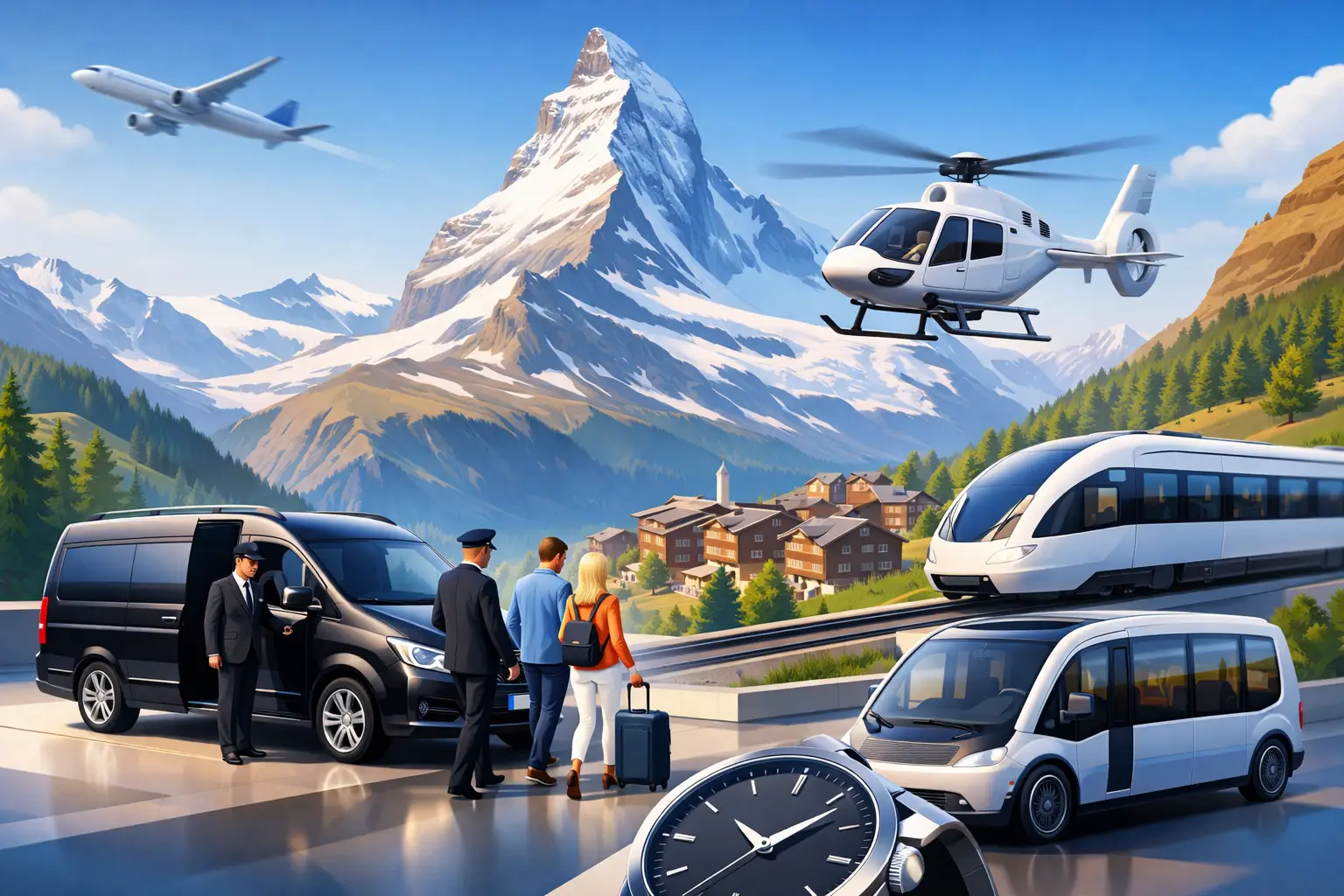
A Zermatt arrival is not a standard Alpine transfer. The final approach ends in Täsch, not at the hotel entrance, because Zermatt is car-free. For guests arriving after a long flight, traveling with ski equipment, hosting clients, or maintaining a tightly managed itinerary, that detail determines whether the journey feels effortless or unnecessarily complicated.
A well-organized private transfer does more than provide a luxury vehicle. It connects flight timing, luggage handling, road conditions, the onward rail or electric-taxi journey, and hotel coordination into one dependable plan. That is the level of preparation Zermatt deserves.
Why Zermatt Requires a Different Transfer Plan
Zermatt’s position at the foot of the Matterhorn is part of its appeal, but it also creates a logistics reality that visitors should understand before they travel. Private vehicles may travel as far as Täsch. From there, guests continue to Zermatt by shuttle train or an authorized electric vehicle, depending on the arrangement and destination.
For a casual weekend with light luggage, this transition can be straightforward. For a family with multiple suitcases, a business traveler on a fixed schedule, or a party checking into a leading mountain hotel, it calls for precise coordination. The goal is not simply to reach Täsch. The goal is to arrive at the hotel calm, on time, and with every item accounted for.
A professional chauffeur service plans the road portion around the actual journey rather than a generic departure time. Flight arrival, baggage collection, customs, traffic around major cities, weather in the mountains, and the scheduled onward connection all matter. This is especially relevant when arriving from Zurich, Geneva, Bern, or an international airport after an overnight flight.
The Value of a Private Zermatt Transfer
The road journey to Täsch is often several hours long. It can be an opportunity to recover after travel, prepare for a meeting, speak privately with colleagues, or simply enjoy the Swiss landscape without managing routes, parking, or changing weather conditions.
A premium transfer gives guests a controlled environment from the moment they are met. A well-maintained Mercedes-Benz vehicle, sufficient luggage capacity, and an experienced chauffeur make a tangible difference on a long Alpine route. For international guests, a multilingual chauffeur also removes small but persistent points of friction, from confirming the destination to coordinating with hotel staff.
Discretion matters just as much as comfort. Executives, VIP guests, diplomatic visitors, and families often prefer a service that operates quietly and without unnecessary attention. A chauffeur should understand when conversation is welcome, when privacy is expected, and when a change in the itinerary needs to be handled without disruption.
There is also a practical advantage to having one accountable point of contact. If a flight is delayed, a meeting runs over, or weather affects the route, guests should not have to reconstruct their transport arrangements from several separate providers. Clear communication and calm operational decisions are part of the service.
Planning the Last Mile From Täsch to Zermatt
The Täsch-to-Zermatt connection is the most important detail to clarify before departure. The village is intentionally free of conventional private traffic, so no chauffeur can drive directly to most hotel entrances in Zermatt. A credible provider explains this clearly and prepares the handover accordingly.
For many guests, the shuttle train is the most efficient option. It operates frequently, carries luggage, and brings travelers into the center of Zermatt. Depending on the hotel location, onward electric transport or hotel collection may then be arranged. The best option depends on arrival time, amount of baggage, mobility needs, the size of the party, and the hotel’s own procedures.
This is where advance communication pays off. Provide the hotel name, the number of guests, and an honest picture of the luggage situation. Ski bags, oversized suitcases, strollers, presentation materials, and formalwear require more planning than a single carry-on. A properly coordinated arrival avoids the uncomfortable moment when guests and luggage are separated or a connection is missed.
For groups, the transfer plan should also account for different needs within the party. Some travelers may want immediate assistance, while others prefer to move independently after reaching Täsch. A flexible arrangement can preserve both efficiency and privacy.
Winter Conditions Change the Schedule
Winter travel in the Alps is highly reliable when handled professionally, but it should never be treated casually. Snowfall, ice, holiday traffic, and changing mountain weather can add time to a journey even when roads remain open. Building a sensible margin into the schedule is not excessive caution. It is the difference between a composed arrival and a rushed one.
The same principle applies to departure. For an early flight from Zurich or Geneva, the journey must begin with the train or electric transfer out of Zermatt, followed by the road transfer from Täsch. Guests should not plan from the airport driving time alone. The car-free final mile must be included from the start.
When a Chauffeur Service Is Most Useful
A private Zermatt transfer is particularly valuable when the journey has a wider purpose than getting from one place to another. Corporate guests may need uninterrupted travel time before a retreat or board meeting. Hotels may require dependable guest transportation for high-profile arrivals. Event organizers may need several vehicles coordinated across different schedules. Wedding parties benefit from a clear plan for guests, formal attire, luggage, and changing locations.
It is equally useful for private travel when convenience is the priority. Parents traveling with children, guests unfamiliar with Swiss rail connections, and visitors carrying winter sports equipment often prefer to have the complex parts handled in advance. The service should remain personal without becoming intrusive.
For multi-stop itineraries, a chauffeur can provide continuity between destinations such as Bern, Interlaken, Gstaad, or Zermatt. This is especially helpful when travelers want to combine city appointments, mountain stays, and airport connections without repeatedly arranging transportation. The right vehicle and chauffeur remain available for the actual itinerary, not just a single point-to-point ride.
What to Confirm Before You Travel to Zermatt
Before a Zermatt transfer is finalized, confirm the flight or pickup details, hotel name, number of passengers, and luggage requirements. If the trip includes ski equipment, pets, children, special mobility needs, or an additional stop, mention it early. These are routine considerations for an experienced provider, but they cannot be handled properly if they are shared at the last moment.
It is also wise to clarify who will monitor schedule changes and how guests will be contacted on arrival. For international travelers without reliable mobile service, a clearly defined meeting point and a chauffeur’s contact details provide reassurance. For corporate bookings, a single coordinator and consolidated reporting can simplify travel management without compromising the individual guest experience.
The vehicle choice should fit the journey rather than appearance alone. A sedan may be ideal for one or two travelers with light luggage. An executive van can be the better decision for families, groups, or guests carrying ski bags. Comfort depends on space, not only on the badge on the hood.
Berner Limousine approaches such journeys with the discipline expected of a premium chauffeur service: punctual coordination, discreet presentation, experienced multilingual chauffeurs, and personal attention from the first pickup through the Täsch handover.
Zermatt rewards travelers who allow enough time for the journey itself. Arrange the transfer around the real route, communicate the details early, and let the first view of the Matterhorn be the beginning of the stay, not the moment the logistics finally end.